Categories

  • White Wines62
  • Red Wines14
  • Sparkling Wines9
  • Sweet Wines3
  • White blends11
  • Red blends5
  • Grappa0
  • Producers

  • Baroni del Mestri
  • Blazic
  • Borgo Savaian
  • Buzzinelli
  • Caccese
  • Carlo Di Pradis
  • Castello di Spessa
  • Colle Duga
  • Drius
  • Due del Monte
  • Gradnik
  • Keber
  • Kurtin
  • Livio Felluga
  • Magnàs
  • Manzocco
  • Picèch
  • Polje
  • Raccaro
  • Renzo Sgubin
  • Sturm
  • Subida di Monte
  • Terre del Faet
  • Toros
  • Vosca
  • Zorzon
  • Cormòns

    Where the hills speak of wine,
    history, and beauty

    Nestled at the foot of Monte Quarin, Cormòns is a succession of hills and vineyards that, in every season,
    welcome visitors with an almost picturesque beauty.
    Cycling routes through the vineyards, walks in the woods, meditation paths, a lively historic center, traditional restaurants, and much more await the traveler in this gem of the Collio.

    In the Heart of the Ancient Town

    Walk through history, squares and elegant palaces


    Piazza XXIV Maggio – The city’s living room

    It has always been the nerve center and the heart of the town’s civic life. The first records of the square date back to 1255, when the residence of the Count of Gorizia was built there.

    In the early 1900s, after a fire, the Municipality began expansion works on Palazzo Locatelli and built the building that is now the Provincial Wine Shop. At that time, the square was home to one of the most important fruit and vegetable markets in the Isonzo area, from which the fruit from the Collio hills departed to be sold in the great European capitals of the time.
    In the 1980s, architect Boris Podrecca, a prominent name in European urban planning, was commissioned to renovate the square – the work was completed in 1990 and, among other things, also pays tribute to Cormons sculptor Alfonso Canciani with the inclusion of a splendid red marble fountain adorned with his work “The Stone Thrower,” facing the bell tower of the Cathedral of Sant’Adalberto.

    Read moreClose

    Palazzo Locatelli

    An elegant 18th-century residence in Palladian style, Palazzo Locatelli houses the municipal offices, the Provincial Wine Shop, and the Civic Museum of the Territory.

    The building takes its name from the Locatelli family from Bergamo, who built it and resided there from the mid-18th century and whose coat of arms is clearly visible on the entrance portal through which one accesses a small but delightful Italian garden, which then opens onto the Municipal Civic Hall and the Civic Museum of the Territory.
    The Museum, dedicated to Alessandro Pesaola, houses works by Alfonso Canciani in permanent exhibition, including various statues and busts and a splendid Monument to Dante, while other temporary exhibitions of various nature are set up during the year.

    Read moreClose

    The Cente

    Cormòns is an almost unique case: within the town there are multiple cente (defensive enclosures), an indicator of the town’s considerable population density even in ancient times.

    The defensive enclosures were named after the church located within them; documented in official records since the early 14th century, the remains of the cente are still visible in parts throughout the town. There were the centa of Sant’Adalberto, the main church located in the historic center, and, in more peripheral areas, the centa of San Giovanni and that of Santa Maria.
    It is likely that these shelters were built in the second half of the 13th century, when tensions between the Patriarch of Aquileia and the Counts of Gorizia intensified, and Cormòns found itself in an area contested by both factions.

    Read moreClose

    Churches and Monuments

    Cathedral of Sant’Adalberto

    The Cathedral of Cormòns, dedicated to Sant’Adalberto, is the main church of the city. The bell tower of this majestic and elegant building is the second highest among all churches in the Archdiocese of Gorizia, after that of Aquileia.

    A church dedicated to Sant’Adalberto already existed in the heart of the town, with records dating back to 1289: the construction of the Cathedral as we know it today, however, began in 1756, incorporating the old structure and partially demolishing the surrounding centa; work was completed only in 1822, when the Cathedral was consecrated by Archbishop Giuseppe Walland.
    Inside are important artworks dating back to the 16th century, while in the basement there are twenty funeral cells containing burial remains from the 17th century. Some of the buried bodies have undergone a natural mummification process, similar to that of the mummies of Venzone.
    The Cathedral’s facade was completed in 1896 to celebrate the nine hundredth anniversary of Sant’Adalberto’s martyrdom. On this occasion, the rose window, created by Cormons craftsman Maghet, and three Carrara marble statues, made by sculptor Girolamo Fiaschi, were placed. The statues represent the Madonna, Sant’Adalberto (patron saint of the parish) and San Filippo Neri (patron saint of the municipality of Cormòns).
    In the nearby Cjase da Plêf Antighe, the House of the Ancient Parish, there is a collection of sacred art: documents, relics, and other works of various nature.

    Read moreClose

    San Leopoldo

    The church of San Leopoldo, in Piazzale Marconi, is a building dating back to the Baroque period, completed in 1716. Originally dedicated to Saints Dominic and Leopold, the church was part of an architectural complex together with the monastery, occupied by Dominican friars.

    During the Napoleonic period, in 1805, the complex was confiscated and in 1849 passed to the community of Cormòns, to which it still belongs today.
    Inside the church there are four side chapels dedicated to Saint Joseph, Saint Francis, Saint Anthony, and the Virgin Mary. The choir, dating back to the early 18th century, is very beautiful, decorated with carved and inlaid wooden stalls.
    Hidden in the heart of the town, San Leopoldo continues to be an important place of worship and a historical-artistic heritage for the community of Cormòns.

    Read moreClose

    Church of the Subida

    The Church of Christ of the Subida, located on the road that climbs from Cormòns towards Medana, is a place of tranquility immersed in a naturally fascinating setting.

    Its construction is linked to a miraculous event that occurred on July 23, 1597: according to popular tradition, a farmer noticed that his oxen knelt before a crucifix placed on a small shrine along the road, from which drops of sweat began to flow. This event, considered miraculous, attracted the attention of the archdeacon, who conducted an inspection and wrote a report sent to the Patriarch of Aquileia.
    Despite the people’s desire to keep the crucifix at the site of the miracle, it was transferred to the Cathedral of Sant’Adalberto. However, the community continued to pray and visit that place, and on August 26, 1597, the first stone of the Church of the Subida was laid.
    The church was built thanks to the contribution of the entire Cormons community, nobles and common people together, and was initially called Madonna della Subida, as reported in historical documents. Today it is also known as the Church of the Crucifix or Church of Christ of the Subida.
    In its suggestive position on a rocky spur immersed in the woods, the Church of the Subida remains an important place of worship today, especially for the Slovenian Community that celebrates its most important moments and festivities here throughout the year.

    Read moreClose

    Giassicco and Santo Stefano

    The village of Giassico, first documented in 1329 as Yasicho, is a hamlet of Cormòns that has preserved its rural and medieval appearance intact. The village embraces a main square that has remained unchanged since the 19th century, surrounded by small stone houses and cobblestone alleys, giving Giassico a charm of bygone times.

    At the center of the village stands the church of Santo Stefano Protomartire, which in its current form dates back to the 15th century, but probably has early medieval foundations. In the second half of the 19th century, the sacristy was added, and in 1885 the current bell tower replaced the original sail-type one.Inside there are various interesting elements: the baptismal font and a holy water font from the 16th century, a 17th-century burial stone, and an altarpiece from 1638 by Udine painter Fulvio Griffoni, depicting the Virgin with Child and Saints Stephen, Charles, and Francis.Giassico is also known for the Festival of Central European Peoples, an annual event celebrating Franz Joseph I’s birthday, bringing together peoples of the former Habsburg Empire with costume shows, music, and fine wine. The village is also home to Palazzo Di Manzano, a pearl of Friulian rural architecture, where Francesco di Manzano, author of the “Annals of Friuli,” was born.
    Exploring this delightful village is like immersing oneself in a journey back in time, through history, art, and cultural traditions.

    Read moreClose

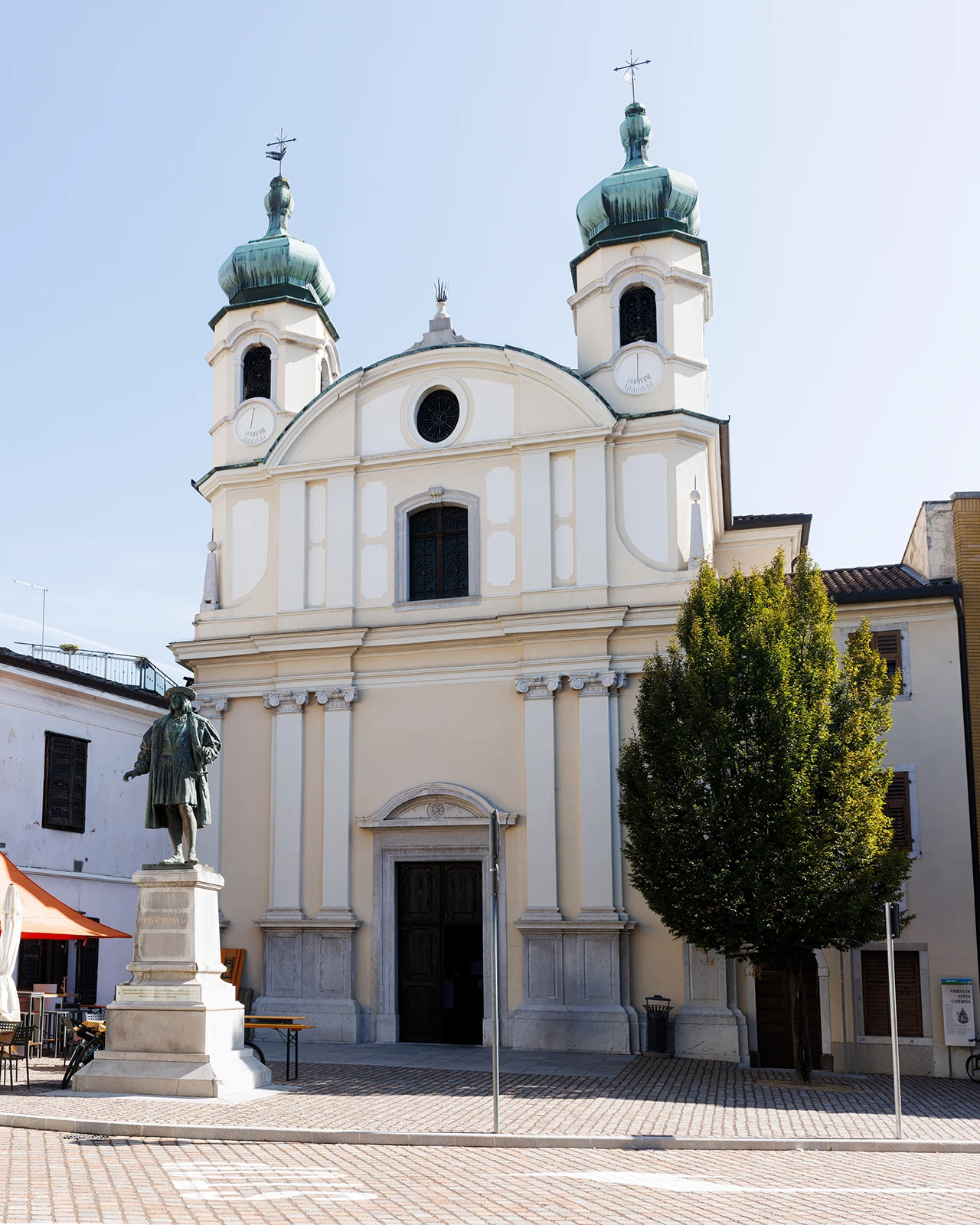
    Statue of Maximilian I

    The statue of Maximilian I of Habsburg stands in the beautiful Piazza Libertà and is a significant historical symbol for the town and its Central European heritage. This work, created by Viennese sculptor Edmund Hofmann, was erected to celebrate 400 years of the County of Gorizia’s belonging to the Habsburg Empire and was solemnly inaugurated on June 14, 1903. However, its history has been marked by numerous vicissitudes.

    The decision to dedicate a monument to Maximilian I was not without controversy, despite the choice being motivated by the connection between the emperor and Cormòns: in 1518, he exempted the people of Cormòns from taxes to compensate them for damages suffered during the long wars, confirming the forms of autonomy granted with the statutes of 1480. This edict, signed in Augsburg on February 11, 1518, is still preserved in the Cormòns town hall.
    With the establishment of Italian authorities at the end of World War I, the statue was removed in 1919 and abandoned in the hospital courtyard. In 1926, a photograph shows the statue lying on the ground, with General Luigi Cadorna among the surrounding people. Subsequently, in 1936, the statue was ceded to the Province, thus avoiding its melting for war purposes, and was then transferred to Gorizia. The statue’s return to Cormòns occurred only in 1981, after years of requests and bureaucratic procedures: since then, the monument to Maximilian I stands majestically in Piazza Libertà, in front of the Rosa Mistica sanctuary, with a plaque on the base that tells its history in four languages (Italian, English, German, and Slovenian).

    Read moreClose

    Walks and Trails

    Discovering a generous and enchanted nature

    Monte Quarin – The balcony over Collio

    Monte Quarin, with its 274m altitude, is a popular destination for hiking and picnics thanks to its panoramic trails and splendid views over vineyards and olive groves.

    It can be reached on foot, by bicycle, motorcycle, or car, and just below the summit there is also a camper van area from which a stairway leads to the Church of the Blessed Virgin of Help, also known as Sant’Anna: a small but fascinating church built in the first half of the 17th century by Baron Luca Del Mestri.

    Since ancient times, there was a castelliere (fortified settlement) on the mountain that served as a shelter point for the inhabitants of the plains and as a control and signaling point; its castle was probably built around the 6th century by the Lombards to defend against the Avars. It later passed under the control of the Patriarchate of Aquileia and, in 1286, to the County of Gorizia. In 1500, the castle and the territories of Cormòns passed to Maximilian I of Habsburg as an hereditary legacy.Today only a few remains of the original structure remain: part of a circular tower, the defensive moat, some sections of the wall, and the guard house). The castle ruins are immersed in a large park dedicated to the noble Ungrispach family, among picnic tables and vineyards that span between Italy and Slovenia composing a single, beautiful panorama.

    Read moreClose

    High Vineyards Trail

    The High Vineyards Trail is one of the most famous hiking routes in Collio, a true naturalistic gem that connects Spessa Castle to the Subida locality. This itinerary, which winds through vineyards, cool and shaded woods, and panoramic hills, offers spectacular views of the plain on one side and Slovenia on the other.

    The path crosses the vineyards of some of the most interesting wineries in Collio and is distinguished by the presence of numerous viewpoints and variants that lead to unmissable destinations such as the Preval plain, the Pradis vineyards, and the small church of Subida.
    The trail is accessible to hikers on foot, mountain bike, and even on horseback. It’s ideal for walks with four-legged friends and can also be traveled by electric cars from Subida to Spessa Castle. The path is well marked with red wooden signs bearing the inscription “Vigne Alte”.
    Among the various starting points are Spessa di Capriva del Friuli, Pradis di Cormons, and Località Subida di Cormons. The route alternates between dirt roads, forest paths, and short stretches of low-traffic paved roads, also connecting to the Collio Geosite in Località Russiz Superiore and, in some sections, coinciding with the Alpe Adria Trail.
    During the excursion, you can admire cypresses, olive groves, cherry trees, and beautiful seasonal flowers such as crocuses, primroses, violets, and snowdrops. Additionally, there are villas, castles, and “panoramic windows” that allow you to immerse yourself in the heart of Collio, a land not only of great wines but much more.
    For those seeking a simple and pleasant adventure, the High Vineyards Trail is an excellent choice, offering an immersive experience in the unique nature and wine landscape of Collio.

    Read moreClose

    Plessiva Forest – A green embrace for all ages

    The Plessiva Forest, located between the municipalities of Cormòns and Dolegna del Collio, is a Natural Park that extends over an altitude ranging from 25 m to 130 m. This park covers an area of approximately 33 hectares and has been owned by the Friuli Venezia Giulia Region since 1968.

    The forest is characterized by a rich variety of trees, including oaks, tall black locusts, and chestnut trees. During World War II, the forest housed an Italian army ammunition depot, and today the remains of military constructions, such as an abandoned powder magazine engulfed by undergrowth, are still visible.

    The Plessiva Forest is easily accessible from its two main entrances: one located to the west, along the road coming from the villages of Ruttars and Brazzano, and the other to the southwest of the village of Plessiva, reachable from Cormòns. Both entrances have gravel areas where cars, campers, and motorcycles can park. The park is open all year round, but the best time to visit is autumn when the leaves take on the warm and vibrant tones typical of the season.
    Inside the park there are numerous facilities, including a visitor center, educational signs illustrating the forest’s flora and fauna, restrooms, children’s play areas, fitness trails with equipment for physical education, picnic areas, and equipped grilling zones. Additionally, there are playing fields for five-a-side football, tennis, and other sports activities.

    The Plessiva Forest offers various trail options:

    • Small loop trail: Starts from the visitor center (entrance no. 2) and crosses an area rich in black locusts, oaks, and chestnut trees, offering a splendid hillside panorama.
    • Large loop trail: A continuation of the small trail, covers the remaining portion of the forest and skirts the northern limit of the park, immersed in an oasis of peace and tranquility.
    • Vita Course: Connects the two entrances and develops along the eastern and southern limits of the park, crossing vineyards and stable meadow clearings.
    • Alpe Adria Trail: A hiking route that connects Carinthia, Slovenia, and Friuli Venezia Giulia. The 31st stage crosses the Plessiva Forest, from the village of Šmartno in Brda to Cormòns.

    The flora of the Plessiva Forest includes a rich variety of plants, such as snowdrops, crocuses, yellow primroses, violets, lungwort, helleborine… The fauna is equally varied, with mammals like wild boars, roe deer, foxes, badgers, and squirrels, and birds including buzzards, sparrowhawks, owls, robins, woodpeckers, nightingales… There are also other guests, such as green lizards, salamanders, tree frogs, and green toads.
    The Plessiva Forest is one of the most suggestive walks to take in the surroundings of Cormòns: an immersive experience in nature, perfect for families, friends, hiking enthusiasts, and mountain bike outings.

    Read moreClose

    The Windows on Collio – Where the border is only beauty

    The Windows on Collio are panoramic little houses created through the Collio Brda Welcome project, a result of collaboration between the regions of Italian Collio and Slovenian Brda. These structures were created to welcome tourists and allow them to admire the beauties of this magnificent territory.

    The Collio, a geographical region of 150 km² politically divided between Italy and Slovenia after World War II, is a homogeneous area with similar traditions and customs. The vineyards that decorate the landscape to the horizon represent the hard work and passion for wine passed down from generation to generation. The Windows on the Collio offer visitors the opportunity to explore this fascinating territory, admiring lush woods, fruit trees, charming ancient fortresses, and splendid vineyards.
    Cycling or walking in these areas, you may encounter the signage of the Alpe Adria Trail, a trekking path that connects Carinthia, Slovenia, and Friuli-Venezia Giulia in 43 stages and about 750 km, from the Großglockner to Muggia. The 31st stage of the Alpe Adria Trail passes right through the Collio, offering you an immersive experience in the breathtaking landscapes and wine history of the region.
    The Collio Brda Welcome project was made possible thanks to a network of local partners who have installed these panoramic stations to allow visitors to enjoy the scenic wonders between Italy and Slovenia. Some of these partners physically host a window, while others act as virtual windows on the territory, thanks to their products and the passion and professionalism that drive their work.
    Thus, by following well-trodden roads and itineraries or creating new paths to discover the Windows on the CollioBrda, you can gaze upon an unforgettable panorama and breathe in the crisp air of this territory, immersing yourself in its rich historical and cultural heritage.

    Read moreClose